









Understanding Popular International Education Programs
Date Submitted: 15/09/2025
In the context of global integration, international education programs are becoming a top choice for students to expand their opportunities for admission to prestigious universities worldwide. However, given the diversity of today’s international programs, parents and students often feel confused and find it difficult to make a decision. This article will help parents and students understand how to categorize and compare some of the most popular international programs in order to make choices that best suit the abilities and future directions of their children.
1. CLASSIFICATION OF INTERNATIONAL PROGRAMS
There are many ways to categorize international education programs worldwide, such as by level of education, by field of study, or by program proportion. To make it easier for parents and students to visualize and compare, we choose to classify programs based on their purpose of use – according to the role and practical significance of each program within a student’s educational journey. Accordingly, international education programs can be divided into four main groups:
1.1. Diploma Programs
These are comprehensive study programs spanning from primary to high school and are globally recognized. Graduation diplomas from these programs allow students to apply directly to international universities, as well as easily transfer schools or study abroad across countries.
Some typical programs:
- IB (International Baccalaureate): Focuses on holistic development and global-mindedness. Includes the IBDP for grades 11–12 with 6 subject groups and 3 core components (Extended Essay, Theory of Knowledge, Creativity-Activity-Service).
- Cambridge (IGCSE & A-Level): Emphasizes subject depth, with IGCSE for grades 9–10 and A-Level for grades 11–12 (students choose 3–4 specialized subjects).
- Other programs: Pearson Edexcel, OSSD (Canada), Australian Curriculum, French Baccalaureate, German Abitur.
1.2. Academic Certificates & Examinations
These are not full study programs but individual examinations assessing specific competencies. They serve as a “supplementary ticket” enabling students to demonstrate academic and language ability, thus strengthening their advantage when applying to international universities.
Some typical programs:
- AP (Advanced Placement): A U.S.-based examination with 38 university-level subjects, scored 1–5, with the possibility of earning transfer credits.
- SAT/ACT: Standardized tests for U.S. university admission, assessing math, reading, writing, and science.
- IELTS/TOEFL: Certificates of academic English proficiency.
1.3. University Preparation Programs
These are short-term (usually 1-year) transition programs from high school to university, designed for international students who need to strengthen their academic foundation, with a focus on English and study skills.
Some typical programs:
- GAC (Global Assessment Certificate): Accompanied by the ACT exam, lasting 1–2 years, recognized by universities in the U.S., Australia, and the U.K.
- Foundation Programs: Bridging courses for universities in the U.K., Australia, and the U.S., often tailored to specific majors.
1.4. National Curricula with International Recognition
These are national education standards implemented in internationalized versions to suit global contexts. This group does not grant independent diplomas but establishes academic frameworks and skill sets that students must achieve to study effectively in diverse international environments.
Some typical programs:
- OxfordAQA: The international version of the U.K. GCSE/A-Level.
- Common Core (U.S.): Standards for Math and English, integrated into U.S. high school programs.
2. OVERVIEW OF INTERNATIONAL PROGRAMS
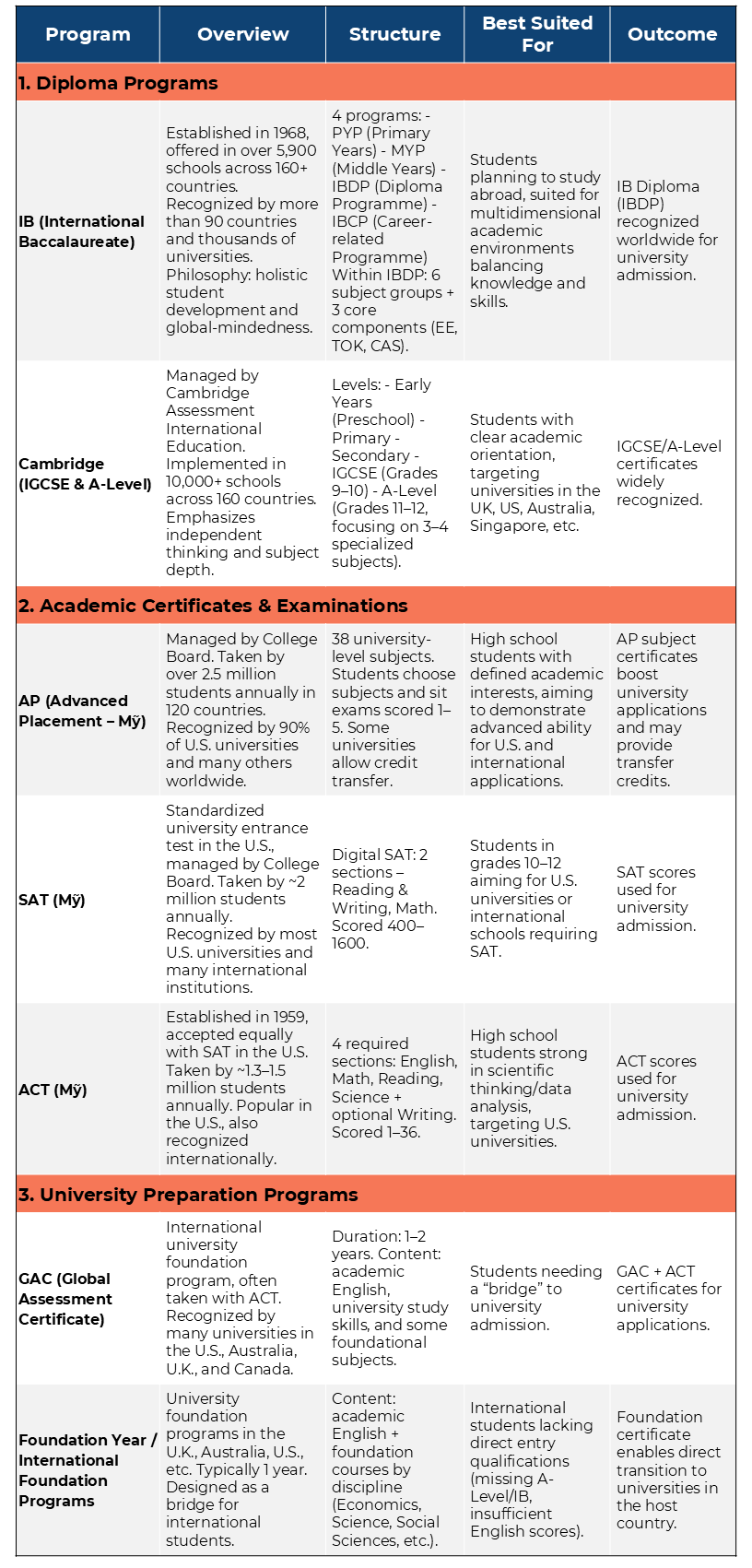
Below is a summary table of general information for parents and students to easily compare (Click on the image to view details):
3. POPULAR INTERNATIONAL EDUCATION PROGRAMS IN VIETNAM TODAY
The international education system in Vietnam is rapidly expanding, covering everything from international diploma programs to academic examinations, supplementary certificates, and university foundation courses. Based on updated data up to 2025, Vietnam currently offers:
- International diploma programs: IB and Cambridge are the most common, with around 21 IB schools and more than 100 Cambridge schools. Other programs such as Pearson Edexcel, OSSD (Canada), Australian HSC/VCE, French Baccalaureate, and German Abitur are available at specialized international schools, granting globally recognized qualifications.
- Academic certificates: Many schools and centers provide preparation for AP, SAT, ACT, IELTS, and TOEFL – essential tools for university applications abroad.
- University foundation programs: GAC and Foundation (U.K./Australia/U.S.) are offered in some partner schools, suitable for students who need a bridging step before university.
- National curricula with international integration: Common Core and OxfordAQA are incorporated in some schools, helping students achieve global standards.
This ecosystem provides diverse opportunities for parents and students to choose the most suitable pathway for study abroad and personal development. However, the number of schools implementing these programs or operating testing centers often changes (expansion, suspension, or program shifts). Therefore, parents and students are advised to check the updated lists on the official websites of international organizations and verify directly with schools before making decisions.
4. INTERNATIONAL EDUCATION EXPERIENCE AT OLYMPIA PRIMARY, MIDDLE & HIGH SCHOOL DANANG
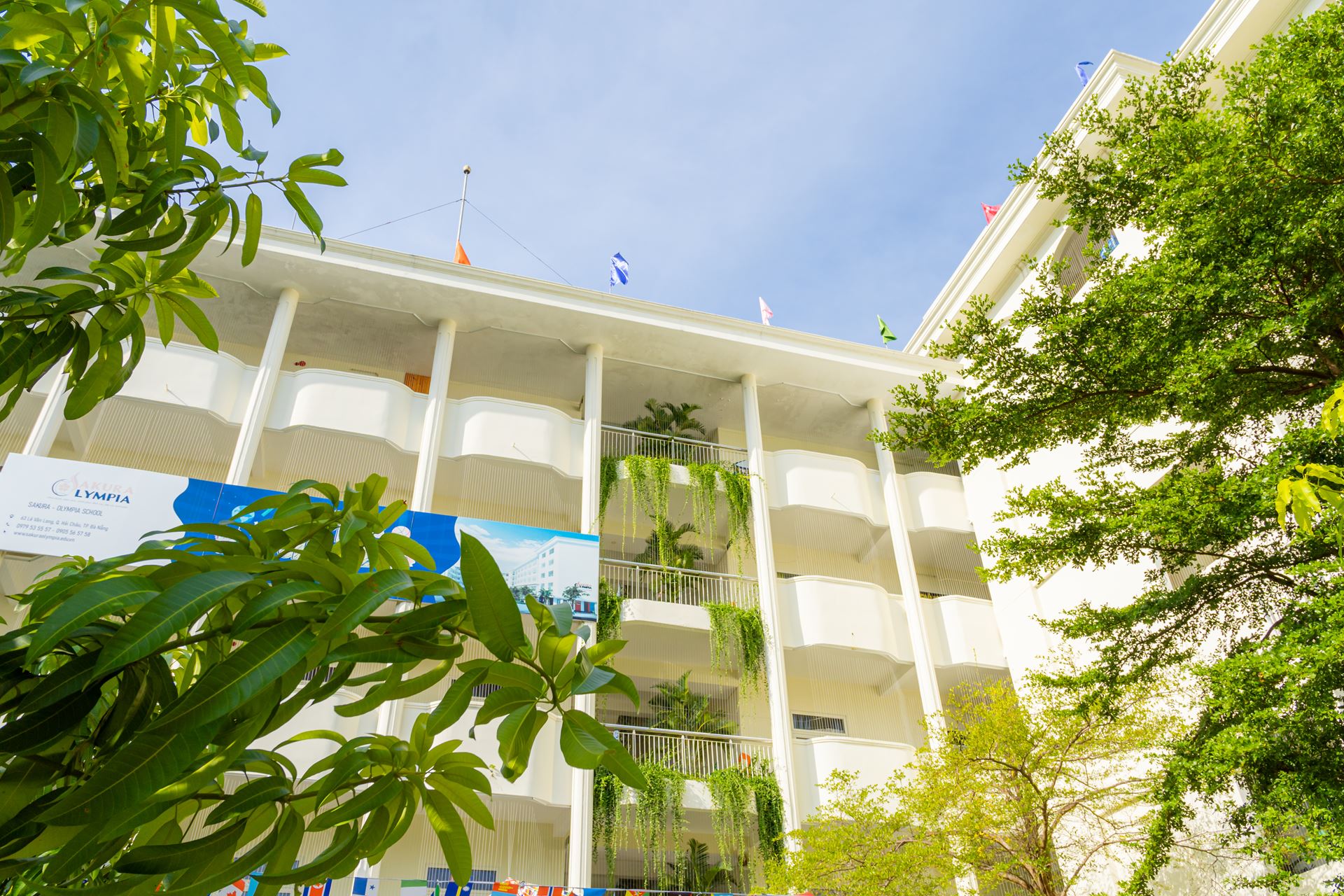
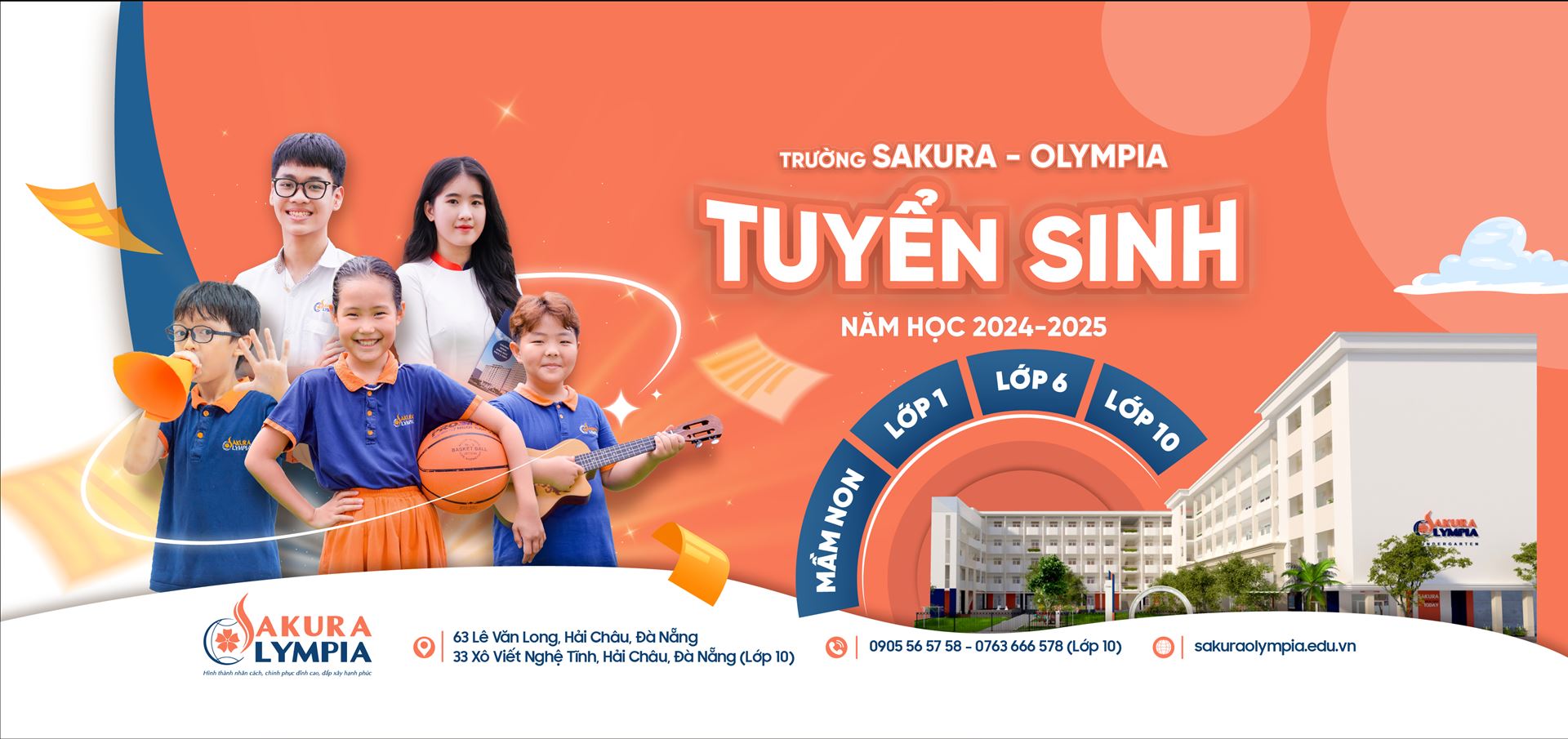
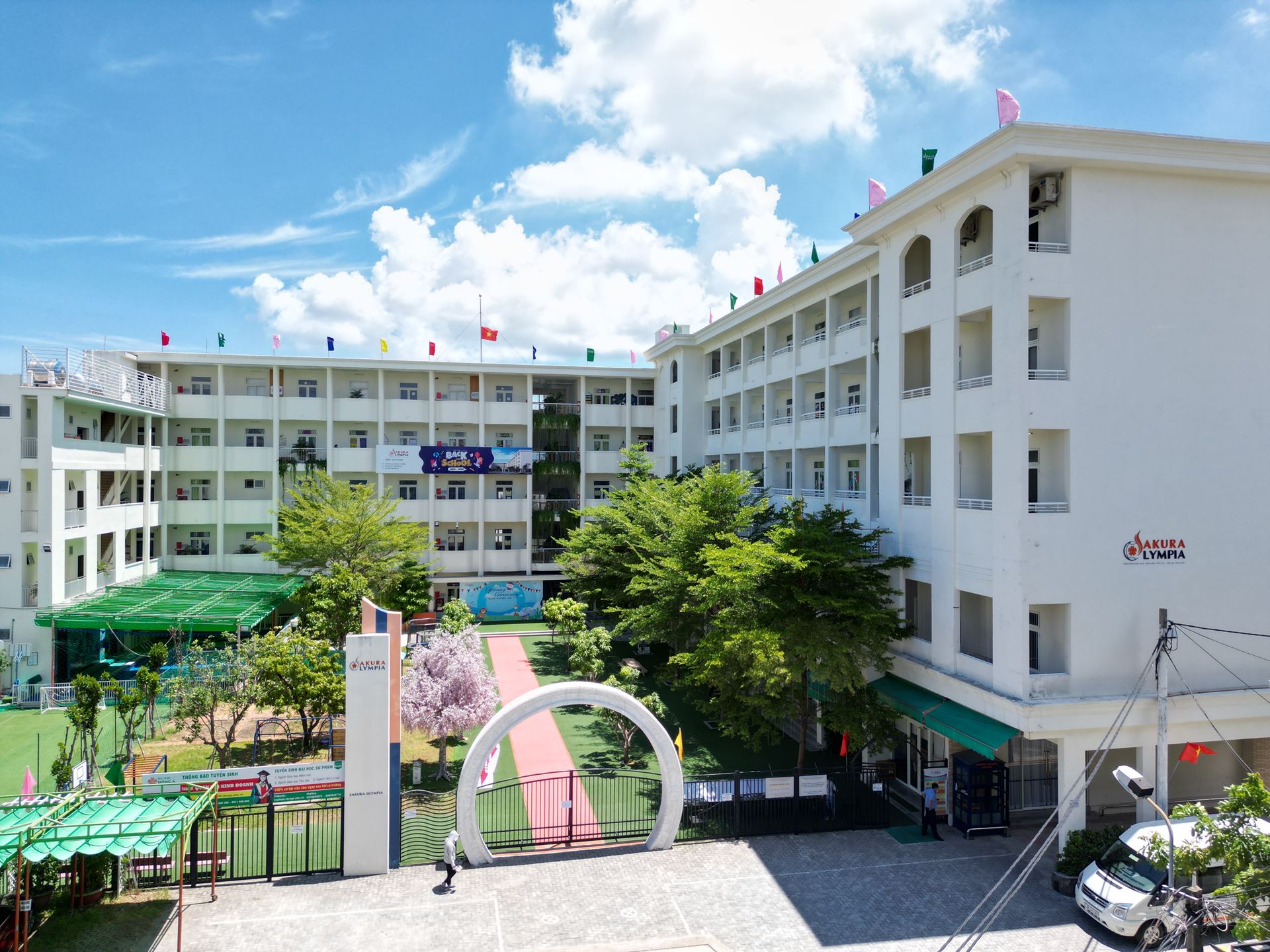
Olympia Danang (a member of the Sakura – Olympia School System) builds a clear international education pathway for students from Primary through High School, focusing on holistic development:
- Grades 1–8:Cambridge Primary (integrated) and Cambridge Lower Secondary–oriented integrated program, combining the Vietnamese national curriculum with international elements to build a strong academic foundation.
- Grades 9–10 (from the 2025–2026 school year): Enhanced Dual-Diploma Preparatory Program, designed to strengthen academic English proficiency, develop critical thinking and research skills, and cultivate independent learning habits in preparation for the integrated dual-diploma pathway.
- Grades 11–12 (from the 2027–2028 school year):Integrated Dual-Diploma Program, preparing students for leading universities worldwide with internationally recognized qualifications.
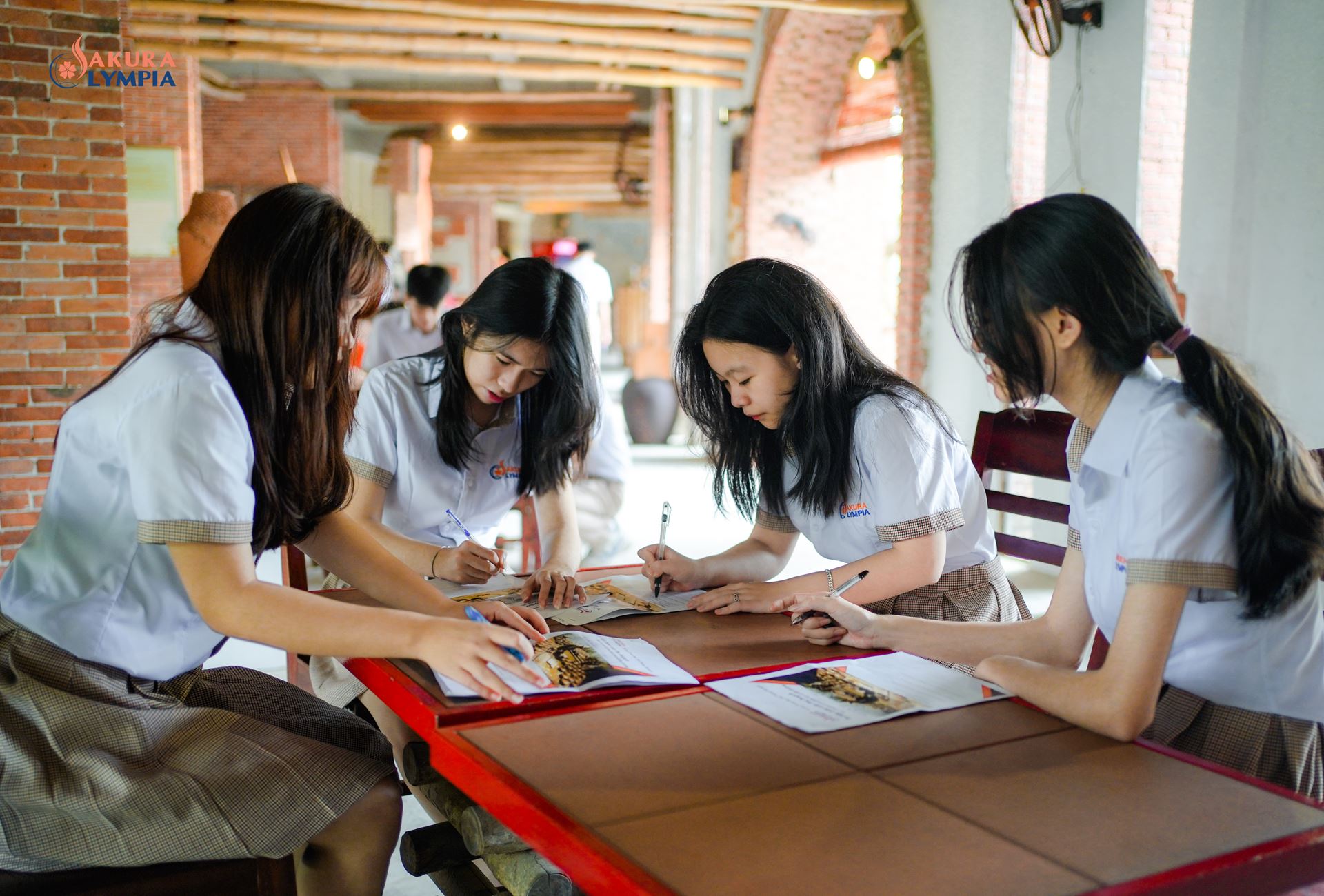
With a modern learning environment, highly qualified teachers, and diverse extracurricular activities, Sakura – Olympia empowers students to confidently integrate into the international community.
For parents interested in learning more about the international programs at Olympia Danang, please contact:
- Admissions & Counseling Office: 63 Lê Văn Long, Hải Châu District, Danang City
- Hotline/Zalo: 0979 53 55 57 – 0905 56 57 58
- Fanpage: Trường Sakura Olympia
- Email: tuyensinh@sakuraolympia.edu.vn
Educational Information and Knowledge Other

HEALTH INFORMATION: HOW TO PREVENT AND CONTROL THE FLU?

Mastering Effective Study and Rest: Unlock Your Academic Potential
